
The Alchemy of Pain and Paper: Inside Mifa's Artistic Universe
Mifa
AUTHOR
Vi Bui
20 Oct 2025
The Alchemy of Pain and Paper: Inside Mifa's Artistic Universe
"Like having an unpredictable conversation: never know what the other person may say and happily accept every potential accident and always ready to make the best out of it."
-Mifa, on her creative process
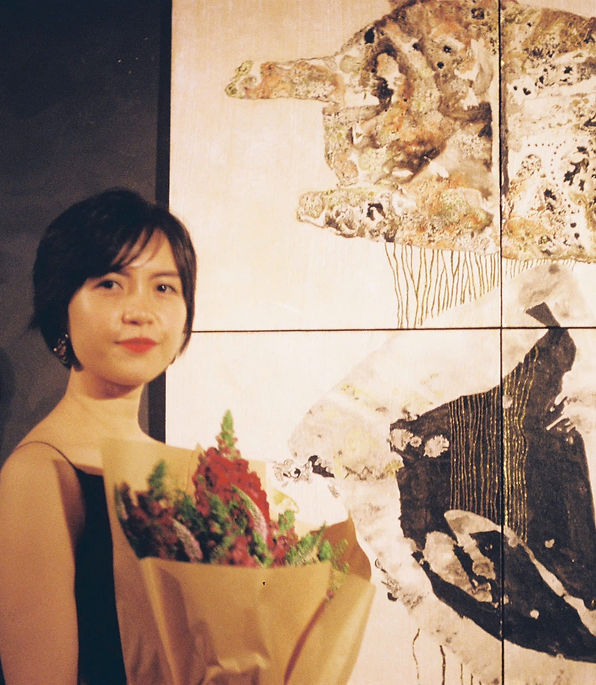
We met Mifa (b.1990) on a sunny yet humid early September day in Hanoi. Over lunch at Chao Ban with the Vietnam Art Collection (VAC) team and Artist-in-Residence Florian Song Nguyen, conversation flowed from Journey to the West [1] to stories of evil eyes, eventually landing on the renowned Vietnamese poet Ho Xuan Huong. Mifa's eyes lit up as she posed an unexpected question: "Were Ho Xuan Huong (1772-1822) and Nguyen Du (1766-1820) the same person? One never knows!" Her fascination with alternative narratives and hidden truths mirrors her artistic approach - finding depth and possibility where others might see only the surface. Much like the scallop paper she works with, Mifa invites us to look beyond the obvious, to discover the luminous particles beneath the everyday.

Getting Lost and Finding Her Way Back to Painting
In an era where digital art dominates conversations, this Danang born-and-raised artist takes us on a different journey - one anchored in tradition yet boldly contemporary. Her relationship with art underwent a profound transformation after what she describes as "losing innocence and developing a fear of painting" following her architecture studies.
Since childhood, Mifa had unconsciously tied her self-worth to her artistic abilities. When she entered university to study industrial design, a field that didn't align with her intuitive approach to art, she experienced a crisis of identity. Receiving average grades for her drawings shook her confidence deeply, as design thinking and mass production were considered over the instinctual expression she had always practiced and taken pride in.
"I was shocked that what I had been most proud of since childhood was now being judged as inadequate," she reflects. This painful contradiction led to a creative paralysis that lasted years, leaving her questioning not just her artistic practice but her fundamental value as a person. The struggle to reclaim the fearless pride she once felt when expressing herself through art, even the "ugly" or difficult parts, continues to shape her work today, as she pushes against the safety of only painting what feels beautiful or acceptable.


If she were to paint the moment before falling in love with this particular material, Mifa imagines it would be "mostly brown, grey, black, turbulent, trembling brushstrokes and pencil, lots of erased parts as I was very insecure and scared of making mistakes, of being looked at. Chaotic, fear, longing for something..."
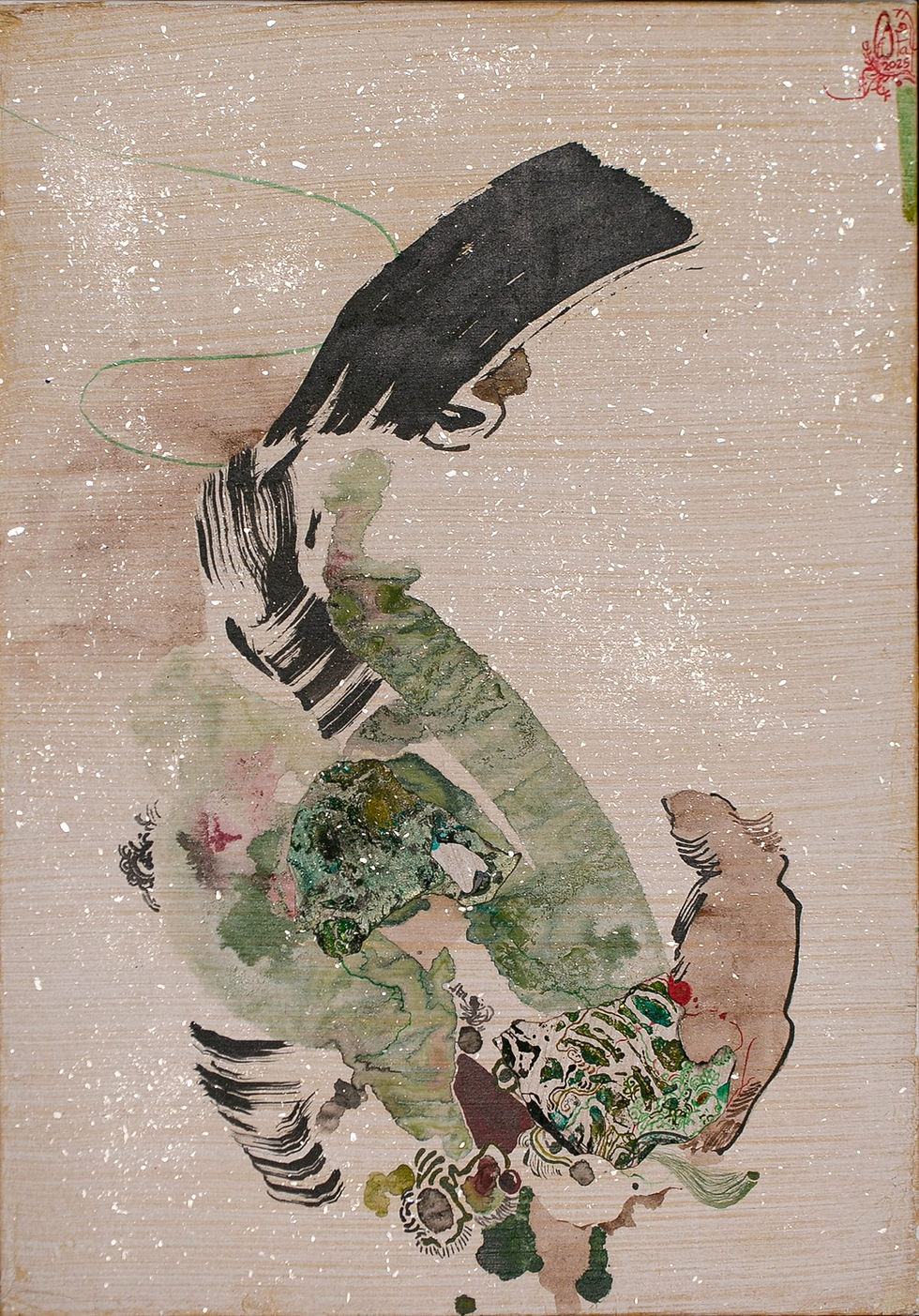
That material was giay diep - a traditional Vietnamese paper flecked with luminous scallop shell particles - that pulled her out of this darkness and reignited her passion. "Scallop paper gives me the spark of wanting to paint again," she explains with quiet conviction.
This traditional material, historically used in Vietnamese folk art, including Dong Ho woodblock printing, became not just her canvas but a collaborator in her artistic expression.
What draws Mifa to combine acrylic - an industrial modern medium - with centuries-old scallop paper? Her answer reveals both pragmatism and poetic sensibility: "I was trying to find my way in painting and use acrylic since the material is flexible and allows me to try different techniques that recreate the effect of calligraphy ink, oil painting, watercolor, wax painting, and even lacquer somehow." When she decided to focus on scallop paper, she applied these same experimental approaches "to see which way can express me the most." The marriage of these seemingly contradictory materials - one ancient, one modern - became for her a matter of "love and effectiveness."


The Dance Between Water and Paper
What makes giay diep particularly fascinating is its inherent unpredictability. "It refuses to absorb water evenly and refuses to be predictable once water touches it," Mifa notes. Rather than fighting against these properties, she embraces them, creating what she calls "the amazing stubbornness of giay diep."
Her technique involves "using water and different density of acrylic painting to let them interact naturally and slowly with giay diep. Wait for the water to dry out during the process and gently intervene at each stage." This delicate dance between control and surrender cultivates surfaces that seem alive with their own agency.


The Architecture of Emotion
Mifa's architectural background might not be immediately evident in her paintings, which often resist rigid precision. Yet she credits this training with giving her "effectivity in exploring, combining, transporting, and preserving" techniques and materials.
Her approach involves multiple layers that intertwine and interact - a visual philosophy that mirrors how she perceives the world. "I love seeing layers of colors intertwined," she says, "I think it is one of the important expressions of how I see the world and how I want to express myself through art."
This layering technique draws inspiration from traditional Vietnamese son mai (lacquer painting), creating depth that invites viewers to look beyond the surface. What makes her process distinct is "the combination of clay printing and the use of different density of acrylic paint with water." She carves patterns "on modeling clay to make prints, inspired by woodblock printing from Dong Ho village (also the usage of giay diep) but easier for the hand."
Fossilized Pain: The Central Metaphor
Perhaps the most striking in Mifa's work is her exploration of pain fossilization - emotion wounds that harden and transform over time. This concept forms the cornerstone of her current artistic investigations at VAC.
"For the work of this project only, I started with suffering emotions through time: fossils-like patterns and stone-like surfaces, lead with a heavy composition, dark and dull colour palette," she explains. "I repeat patterns to express repeated suffering, suffocation, grief."
In contrast, she represents fresh wounds differently: "For the fresh wound and fresh pain, I use the contrast of burning orange color and the brushstrokes to express a strong flow: emotions, blood, words, crying..." This visual language of pain creates a powerful tension in her work, between what has hardened into memory and what still bleeds fresh.
Currently in residence at VAC Hanoi, Mifa is developing work inspired by a heartbreaking story from the 2021 COVID lockdown in Vietnam. A low-income couple journeying home on two old motorbikes with their fifteen dogs became a brief media sensation. Upon reaching their hometown quarantine center in Ca Mau, all fifteen dogs were killed under local health authorities' orders. The story filled her, and many others, with rage and profound sadness, but what struck her most deeply was how quickly such tragedies fade from public consciousness.
This experience crystallized her artistic concept that "some people's pain can be too deep and heavy as if they are fossilized, but they are just news or fleeting emotion of sympathy for others." The VAC residency, by removing her from the rhythms of daily life, has given her space to transform this powerful observation from concept to canvas.
When reflecting on what makes certain pain too private to fossilize publicly, Mifa notes that shame may be the ultimate private suffering. Yet she observes a curious evolution in her own relationship with vulnerability. Before her crisis with painting, she felt proud to express even her most personal and distorted emotions. Afterward, she began feeling pressure to paint only what felt safe to share, hiding the rest - a challenge she continues working through in her relationship with herself and her art.

Nature as an Emotional Landscape
Growing up with a frequently absent mother, Mifa spent considerable time in her mother's garden, developing what she calls "a strong sense of solitude." This early relationship with nature deeply influenced her artistic perspective.
"Nature has been a strong influence on my emotions and an important object for my imagination for too long that I don't intentionally think about depicting nature in my painting at all," she reflects. "They are there as a part of my expression and my emotions."
This approach aligns with Eastern philosophical perspectives she embraces, where humans are viewed not as separate from nature but as integrated within it. Her paintings express "not from human-centered view and measurement where things have to be the way humans see it," creating landscapes that feel both familiar and otherworldly.

The Poetry of Materials
Mifa draws inspiration from diverse cultural sources, particularly poetry in various forms that influence her "brushworks, details, patterns, the overall spirit of the painting."
The Persian Rubaiyat, a collection of quatrains by 11th-century poet Omar Khayyám, exerts "the most pervasive influence," she notes, with its "deepest and most familiar intensity." For Mifa, invoking the Rubaiyat symbolizes her profound connection to the artistic spirit and humanistic values of Islamic culture. Within this cultural framework, she finds resonance for what she describes as her own "endless longing for beauty and poetry from an ugly being" - a poignant self-reflection that speaks to the transformative power she seeks in art. These inspirations materialize in her paintings through "blue color, so blue that somehow calms my heart and lights a fire in my soul, heavy stones, tragedy, turbulence, anger, pain, poetry, pattern, details, gold, strong contrast of being human, morality and moral conflicts."
Besides that, Chinese calligraphy also influences her brushwork, inspiring a "wind of freedom, fearless, start with the urge to be fearless and release my wind, the urge to feel free, and to feel that I do have bravery, also the longing for sophistication and refinement."
Meanwhile, Japanese Haiku contributes "compassion, tranquility of daily smallest moment of emotions, minimal expression, start with an overwhelming feeling of compassion."
Her gold leaf technique on giay diep - inspired by gilding techniques, Quran decoration, and the work of artist Khadim Ali [3] - adds another dimension to her material explorations. These diverse influences coalesce into a highly personal visual language that refuses easy categorization.
When asked what Ho Xuan Huong might say if she could see Mifa's work today, she responds with characteristic humility. The 18th-century Vietnamese poet known for her boldness and daring expressions through veiled eroticism and social critique would likely urge Mifa toward greater courage in her artistic expression. Despite the centuries between them, there's a kinship in their relationship to tradition, both working within established forms while seeking to transform them from within.


The Geography of Creation
Based in Da Nang, Mifa finds the city's "slow rhythm, secluded community" conducive to her work, providing "lots of solitude" alongside the emotional security of being close to family. "Feeling of hometown, close to parents, feeling loved. Important emotional capital," she summarizes.
She sees a meaningful connection between the scallop shells in giay diep and Da Nang's beaches, honoring this relationship by "developing techniques that emphasize the sparkling of scallop speckles as much as possible."
When asked about her commitment to preserving and reimagining traditional Vietnamese materials, her answer is refreshingly simple yet profound: "Naivete. Innocence. The feeling of belonging to a country is one of the most important emotional capitals for humans."

The Conversational Canvas
Mifa approaches her canvases with minimal preliminary sketching, preferring to work intuitively. She likens her creative process to "having an unpredictable conversation: never know what the other person may say and happily accept every potential accident and always ready to make the best out of it."
This philosophy reflects her broader perspective on art-making as dialogue rather than monologue - both with her materials and eventually with her audience. In this way, painting becomes less about imposing vision onto passive materials and more about cultivating a relationship with them, allowing their inherent properties to partially dictate the final outcome.
Looking Forward
With a solo exhibition planned for 2027, Mifa is also curious about experimenting with ceramics in the future. When asked what questions she hopes visitors might ask about her work, she reveals a desire for "intriguing questions that make me reflect hard on the things that I find uneasy to face. With a well-intentioned and constructive spirit, of course."
In a contemporary art world often fixated on technological innovation, Mifa's commitment to traditional Vietnamese materials feels both radical and necessary. Her work reminds us that true innovation can sometimes mean looking backward to move forward - finding within ancient practices the spark for new creative pathways.
Through her alchemical combination of giay diep and acrylic, Eastern philosophy and personal experience, Mifa creates art that feels simultaneously rooted in Vietnamese cultural identity and speaking to universal human emotions. On the sparkling surface of her paintings, we glimpse both the fossilized pain of the past and the shimmering possibility of transformation - a conversation between what endures and what evolves, between what we remember and what we create anew.


Footnotes:
[1] Journey to the West (西遊記, Xī Yóu Jì) is a 16th-century Chinese novel attributed to Wu Cheng'en. Being one of China's Four Great Classical Novels, it follows the pilgrimage of the Buddhist monk Xuanzang and his three disciples, including the famous Monkey King, Sun Wukong - as they journey to India to obtain sacred texts. The novel blends adventure, mythology, and spiritual allegory, and has been adapted countless times across various media throughout East Asia.
[2] In an artist statement for "There is something about Innocence one is quite never resigned to lose" (2021), Mifa wrote: "I grew up with a keen curiosity for the vivid colors of an adult mind that's still yearning for the past, and an all-out effort to hold on to the childhood innocence. After all, there is something about innocence one is never quite resigned to lose. Still, the more obsessive I become of ‘innocence’, the further I stray away from it.
‘Innocence’ is such a strange thing that’s so hard to take hold of, for the moment one’s aware of it, one risks losing it. Having said that, there is still something in us that never ceases to be (though manifested less frequently at present than in the past), because every moment of our presence projects a different truth about ourselves. Any act of reflection - for me - is similar to looking into a broken mirror, with each fragment giving an illusion of a clear image, yet those images are never the complete reflection of our complex mind. Every time we change our vantage point, the image reflected becomes different.
The same applies to the relationship between the consciousness forged by life experiences and the innocent instincts, manifested sometimes as a gentle touch and sometimes as an infiltration causing violent fractures. That very innocence is at times in existence, at times broken, hidden or lurking somewhere in between our layers of thoughts as we grow older."
“There is something about innocence one is never quite resigned to lose.” <The Innocent – Graham Greene>
[3] Khadim Ali (b. 1978) is an Afghan-Australian artist of Hazara background who combines traditional Persian miniature painting techniques with contemporary themes. Trained in Pakistan and Iran in miniature painting, calligraphy, and mural painting, his work often features gilding and draws from Persian mythology to explore displacement, cultural identity, and war. Ali has exhibited globally, including at documenta 13, the Venice Biennale, and the Guggenheim Museum.
SHARE


Explore More

In Studio
Mifa
The Alchemy of Pain and Paper: Inside Mifa's Artistic Universe

In Studio
Lien Pham
Intimate Narratives

Spotlight
Vy Trinh
In Conversation

In Studio
Tra My Nguyen
Transformation doesn’t erupt—it seeps

In Studio
Nhi Le
Space and Performance Bodies

Spotlight
Vo Huynh Phu
Unraveling the Possibilities

In Studio
Lam Na
From Earth, Rebirth was Born

In Studio
Hà Ninh Pham
Through the territories

In Studio
Mai Ta
Canvas as a Threshold to the Inner Soul

In Studio
Diane Severin Nguyen
Seeing Beyond Systems: Representation, Identity, and Resistance

In Studio
Trinh Cam Nhi
Alternate Perspective
